Your Students Already Have Cameras. Here’s How to Turn Them into Learning Tools

Walk through almost any school hallway and you’ll see students carrying one of the most powerful creative tools ever invented.
A smartphone.
Inside that small device is a camera students use constantly — to document their lives, share ideas, communicate with friends, create videos, capture events, and make sense of the world around them.
Photography is no longer a specialized hobby reserved for students with expensive cameras or darkroom access. It has become part of everyday communication.
Students photograph science experiments, school events, artwork, field trips, projects, friends, pets, meals, sunsets, sports, and moments they want to remember. They communicate through images long before they enter college or the workforce.
And yet, despite photography’s growing importance, many teachers still hesitate to bring it into the classroom.
Not because students aren’t interested.
Not because photography isn’t useful.
But because many teachers quietly wonder:
“Am I qualified to teach photography?”
That hesitation makes sense.
 Teens working on the High School yearbook
Traditional photography courses often begin with technical terms: shutter speed, aperture, ISO, exposure, lenses, focal length, file types, and camera settings.
For teachers who are not photographers, that can feel overwhelming fast. Most educators already have full schedules, crowded classrooms, and a long list of required standards to meet. Adding “learn photography” to the list can feel like too much.
But here’s the encouraging truth:
Photography does not have to begin with camera settings.
In fact, for most students, it shouldn’t.
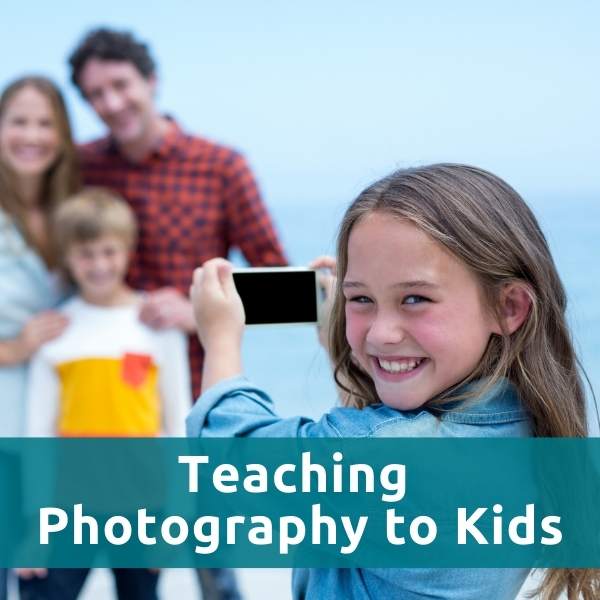
 Students can learn photography basics in every day settings.
Before students need to understand manual mode, they need to learn how to see.
They need to notice light.
They need to recognize patterns.
They need to think about what belongs inside the frame and what should be left out.
They need to ask simple visual questions:
What is the subject of this photo?
Where is the light coming from?
What is distracting in the background?
How does this image tell a story?
What happens if I move closer, lower, higher, or farther away?

These are not questions only professional photographers can teach. They are questions any thoughtful teacher can guide students through.
That is what makes photography such a powerful classroom tool.
It helps students slow down and observe.
It gives them a reason to look more carefully.
It turns ordinary surroundings into learning material.
A hallway becomes a lesson in leading lines.
A window becomes a lesson in light.
A playground becomes a study in motion, shape, pattern, and perspective.
A student’s desk, backpack, hands, shoes, or shadow can become the beginning of a visual story.
Photography gives students a concrete way to practice creativity, communication, critical thinking, and problem-solving — all at the same time.
Photography Belongs Across the Curriculum

One of the most exciting things about photography is how naturally it supports learning in almost every subject area.
In science photography, students can photograph plant growth, shadows, reflections, weather changes, patterns in nature, or the properties of light.
In math photography, students can explore symmetry, angles, geometry, scale, perspective, and repeating patterns.
In language arts photography, students can create photo essays, visual poems, character portraits, image-based story prompts, or visual journals.
In social studies photography, students can document local history, community spaces, cultural traditions, neighborhood change, or everyday life.
In journalism, yearbook, media, and communications classes, photography gives students practical experience creating images with purpose and meaning.
 Using photography in science
Photography also works beautifully in enrichment programs, homeschool settings, after-school clubs, summer camps, and project-based learning.
And the best part?
Students do not need professional cameras to begin.
A smartphone is enough.
A tablet is enough.
A simple point-and-shoot camera is enough.
A DSLR or mirrorless camera can be wonderful, but it is not required.
The goal is not to turn every student into a professional photographer. The goal is to help students become stronger observers, more intentional creators, and more thoughtful visual communicators.
A Simpler Way to Teach Photography

Picture Power has always believed that photography education should be accessible, practical, and inspiring — not overwhelming.
That belief is at the heart of the new Photography Teaching and Activities Kit.
The kit was created for teachers, homeschool parents, enrichment leaders, and program facilitators who want to introduce photography in a clear, engaging way without needing to be camera experts themselves.
Instead of starting with complicated equipment or technical theory, the kit helps students begin where photography really begins:
... with seeing.
Students explore composition, light, visual storytelling, camera basics, creative challenges, and photo review through simple lessons and hands-on activities.
They learn by making photographs.
They learn by looking at examples.
They learn by trying, comparing, discussing, and improving.
And teachers are given the structure they need to guide the process with confidence.
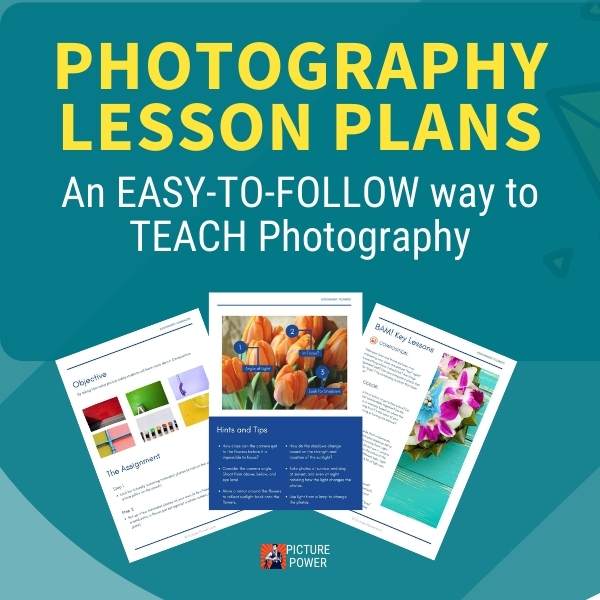
The new teaching kit expands beyond Picture Power’s original Photography Lesson Plans to include a fuller set of classroom-ready teaching materials, including lesson plans, a teacher’s guide, student workbook pages, study guides, photo flash cards, creative challenges, and photography activities that can be used in a wide variety of learning environments.
It is designed to be flexible.
Use one lesson.
Add a photography activity to science, writing, social studies, or art.
Support a yearbook or journalism program.
Give early finishers a meaningful creative challenge.
Use photography as a bridge between observation, storytelling, creativity, and real-world learning.
Photography TEACHING & ACTIVITIES KIT (Printables)

Jump right into teaching photography with our exclusive Photography Teaching & Activities Kit
Includes:
- 10 Photography Lesson Plans
- Teacher's Guide
- Student Workbook
- 3 Photography Study Guides
- 30-Day Photography Challenge
- 52 Cut-Out Photo Flash Cards
- Photo Scavenger Hunt
Why Photography Matters Now

Students are growing up in a world shaped by images.
They see photographs constantly in social media, advertising, news, entertainment, education, and everyday communication.
Helping students understand photography is not just about helping them take better pictures. It is also about helping them become more thoughtful visual thinkers.
When students learn photography, they begin to understand that every image involves choices.
Where to stand.
What to include.
What to leave out.
When to take the picture.
How light changes the mood.
How framing affects meaning.
How one photograph can inform, persuade, document, celebrate, or distort.
Those lessons matter.
They help students create stronger images, but they also help students better understand the images they see every day.
Photography teaches students to pay attention.
And in a fast-moving world, paying attention is a powerful skill.
You Don’t Have to Be a Photographer to Teach Photography

Perhaps the biggest myth about teaching photography is that the teacher has to know everything first.
You don’t.
You do not need to be a professional photographer.
You do not need expensive equipment.
You do not need to explain every camera setting on day one.
You only need a clear path, a few strong guiding questions, and activities that help students practice seeing with intention.
Photography is not just about cameras.
It is about curiosity.
It is about noticing.
It is about making choices.
It is about helping students see the world — and their own ideas — more clearly.
And that makes photography one of the most useful, flexible, and exciting teaching tools available in today’s classroom.
The smartphone is already in students’ hands.
Now we can help them use it with purpose.
More from picture power


A COMPLETE PHOTOGRAPHY TEACHING KIT
**BRAND NEW FOR 2026!


Search
Picture Power