Picture Power Progressive Learning
rethinking how we teach photography

Most students already know how to take a picture.
They can point a camera or smartphone at something, press the shutter and produce an image. So when we begin teaching photography, the most important question isn't:
How do we teach students to take pictures?
It's:
How do we teach students to make increasingly intentional photographs?
That requires more than a collection of interesting photography assignments or an understanding of the exposure triangle.
It requires a progression of considered intention.
One skill should prepare students for the next. Ideas introduced early should return later in more sophisticated ways. And by the end, students should be able to bring those individual skills together and use them for a purpose of their own.
That's the thinking behind Picture Power's approach to teaching photography.
Start with the simplest photographic decision
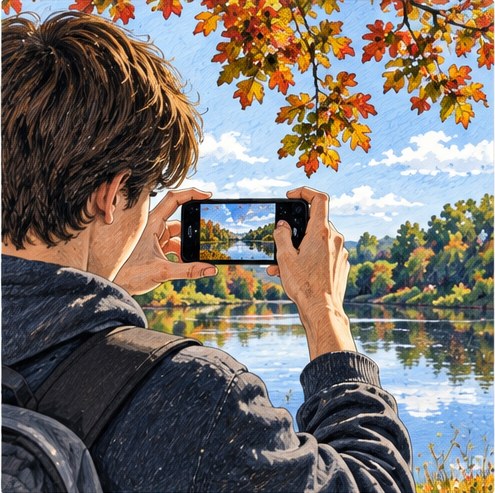
Photography begins with a rectangle.
Before students need to think about camera controls, they can learn that they are responsible for deciding what goes inside that rectangle and what stays outside.
That's why the progression begins with Framing — Learn to Choose.
From there, students begin actively searching their surroundings through Patterns & Repetition — Learn to Notice.
The shift may seem small, but it's fundamental.
Students move from:
There's something interesting. I'll take a picture.
toward:
There's something happening visually. I noticed it. Now I'm going to decide how to photograph it.
The camera is becoming an observation tool.
Each new lesson adds another decision

Once students begin noticing visual relationships, they can start organizing them.
Leading Lines — Learn to Direct introduces the idea that photographers can influence where viewers look.
Minimalism — Learn to Simplify asks students to protect that attention by deciding what can be removed.
Then Close-Up — Learn to Investigate changes their physical relationship to the subject. Instead of looking for something new, students move closer and discover more in what's already there.
These aren't isolated tricks.
They're accumulating decisions.
Choose.
Notice.
Direct.
Simplify.
Investigate.
Students are building a way of working.
then light changes everything
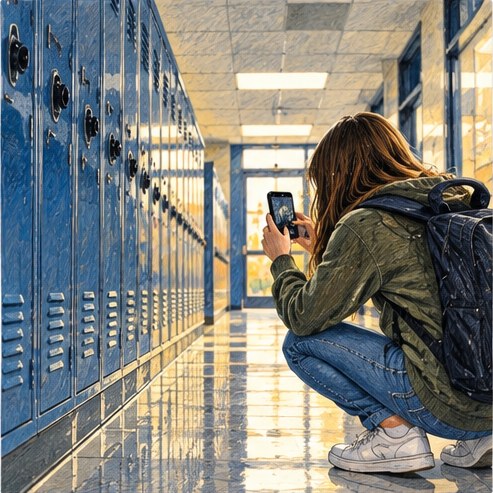
The first part of the progression concentrates heavily on composition—what students put into the photograph and how they organize it.
Then the emphasis begins to shift.
Shadows — Learn to See Light introduces the idea that photography isn't only about objects and scenes. Light itself creates photographic possibilities.
Reflections — Learn to Transform takes that understanding further. Students discover that water, glass, mirrors and other surfaces can duplicate, distort, layer and transform familiar things.
Now students aren't simply responding to subjects.
They're responding to what light is doing to those subjects.
Their photographic world has become larger.
Make the problems progressively harder
Once students have some control over composition, viewpoint and light, they're ready for situations that demand several skills at once.
Action — Learn to Anticipate introduces timing.
The photographer can't simply look carefully and take as long as necessary. Something is happening. Students have to observe, predict, position themselves and recognize the right moment.
Then comes Maximalism — Learn to Manage Complexity.
Earlier, Minimalism taught students to remove distractions.
Now the challenge becomes harder:
Keep the complexity—but organize it.
More objects. More people. More colors. More layers. More visual information.
Students aren't abandoning what they learned earlier. They're being asked to use it under increasingly demanding conditions.
Eventually, technique should serve an idea

That leads to Self-Portraits — Learn to Say Something.
By now students have a collection of photographic choices available to them.
They understand framing.
They notice visual relationships.
They can direct attention.
They understand simplification and complexity.
They investigate viewpoint and detail.
They recognize light.
They can experiment with transformation and timing.
So the question changes.
Instead of:
Can you demonstrate this photography technique?
we can ask:
What do you want to communicate—and which photographic choices will help you communicate it?
That's why Self-Portraits come last.
The student is no longer learning a technique simply because it's today's assignment.
Technique begins serving meaning.
The lessons don't disappear when they're finished
This is central to the model.
Students don't finish Framing and stop thinking about framing.
They use it when photographing patterns.
They use it with leading lines.
They use it to simplify a minimalist photograph.
They use it when working with shadows, reflections and action.
By the time they reach Maximalism and Self-Portraits, framing should no longer feel like Lesson 1.
It should feel like photography.
The same is true of the other lessons.
Skills accumulate.
Earlier decisions become habits.
New problems require students to retrieve and combine what they've already learned.
That's what makes this a progression rather than a list of photography activities.
Portfolio & Review — Reflect
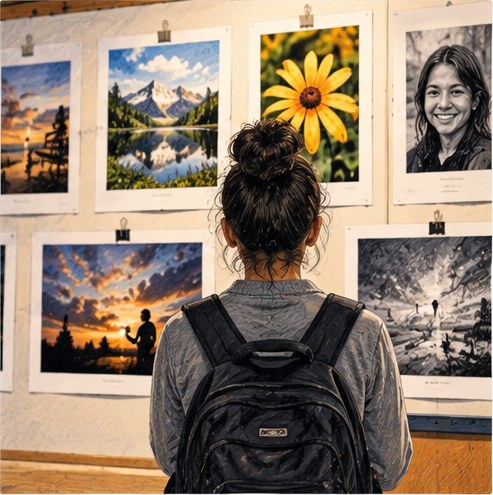
Before the first lesson, students can make one photograph with almost no instruction:
Take a photograph you think is interesting.
Save it.
Then, as students progress through the lessons, they select photographs that demonstrate what they're learning.
At the end, they return to that first photograph and look across the work they've produced.
Now ask:
What do you notice now that you didn't notice when you began?
The answer matters more than whether every photograph is technically perfect.
Students can see evidence of changing attention, stronger choices and greater intention.
They haven't simply accumulated photographs.
They've accumulated ways of seeing.
Photography education can be about more than photography
This is ultimately why the progression matters.
Learning photography can teach students to slow down.
To notice.
To investigate.
To recognize relationships.
To make choices.
To anticipate.
To distinguish what matters from what doesn't.
To communicate an idea visually.
And finally, to look back at their own work and recognize growth.
The course begins with a student holding a camera and deciding what belongs inside a rectangle.
It ends with that student understanding that every photograph contains choices—and that those choices can affect what another person notices, feels or understands.
That's the larger progression:
From taking pictures to making photographs.
And eventually:
From looking at the world to learning how to see it.
Rethinking photography Education
Picture Power’s approach to photography education begins with a simple idea: knowing how to operate a camera is not the same as knowing how to make a photograph.
Understanding ISO, shutter speed, and aperture can give students technical control, but it does not teach them what deserves their attention, what to include or leave out, when to wait, where to stand, or what they want another person to see and feel.
By teaching students to notice, choose, simplify, anticipate, interpret, and express, photography becomes more than a technical skill. It becomes a practice in awareness.
Students learn to look more closely at their surroundings, consider perspectives beyond their own, and make intentional choices about how they represent the world and the people in it.
The goal is not simply to create better photographers, but more observant, thoughtful, and considered people.
Photography TEACHING & ACTIVITIES KIT (Printables)

Jump right into teaching photography with our exclusive Photography Teaching & Activities Kit
Includes:
- 10 Photography Lesson Plans
- Teacher's Guide
- Student Workbook
- 3 Photography Study Guides
- 30-Day Photography Challenge
- 52 Cut-Out Photo Flash Cards
- Photo Scavenger Hunt
More from picture power



recommended for you
7 Low Light Digital Photography Tips
The test of a good photographer is not how well they shoot in good light, but how they handle a low-light situation. Here are some basic tips on shooting low light digital photography.
Engagement Photo Ideas For Wedding Photographers And Couples
Whether you use props, matching outfits or a unique setting, get inspired with these engagement photo ideas.
Fun Photography Ideas | Tips for photographing toys and memorabilia
These fun photography ideas can turn a boring day into a day of adventure. Give your toys the attention they deserve and learn how to think like a cinematographer.



A COMPLETE PHOTOGRAPHY TEACHING KIT
**BRAND NEW FOR 2026!





Search
Picture Power