Picture Power in the classroom
How Photography Teaches Students to Notice What Others Overlook

Every academic discipline begins with the same act.
Not solving.
Not writing.
Not calculating.
Observing.
Scientists observe before they hypothesize. Historians observe before they interpret evidence. Writers observe before they describe. Engineers observe before they design. Artists observe before they compose.
Yet observation is rarely taught as a deliberate, transferable skill. Instead, educators often assume that students naturally become better observers as they mature. Research in cognitive science and educational psychology suggests otherwise. Novices and experts differ not primarily in intelligence, but in what they notice. Experts recognize meaningful patterns, relationships, and anomalies that novices simply overlook.
If observation can be strengthened, then it should be treated as a foundational literacy—one that supports every discipline rather than belonging to any single one.
Photography offers an unusually effective medium for developing that literacy because it externalizes the process of looking. It requires students to justify attention. Every photograph becomes evidence of what the student considered worthy of notice.
The educational question, therefore, is not whether photography belongs in schools.
The more productive question is this:
How can photography become an integrated methodology for teaching observation throughout an entire curriculum?
The following three frameworks provide one answer.
Observation Before Explanation

One of the persistent challenges in education is that students frequently explain phenomena before they have thoroughly examined them.
Consider a biology classroom.
A student identifies a leaf as "damaged."
An experienced scientist asks:
What specifically do you observe?
The distinction is profound.
"Damaged" is an interpretation.
Brown edges.
Small circular holes.
Irregular discoloration.
These are observations.
Photography naturally separates observation from interpretation because students must first identify what deserves recording.
Imagine a school-wide instructional routine in which every major unit begins with photographic observation.
Before writing.
Before discussion.
Before lectures.
Students photograph.
History students document architectural details within their community.
Mathematics students collect examples of proportional relationships.
Language Arts students photograph scenes that communicate mood without words.
Chemistry students record examples of oxidation.
Geography students investigate evidence of erosion, drainage, and land use.
The intellectual habit remains constant.
Observe before concluding.
Schools often teach students how to answer questions.
Photography helps students learn how to see the question first.
Visual Evidence as Academic Evidence

Across disciplines, students are routinely asked to support claims with evidence.
Yet evidence is often introduced only after ideas have already formed.
Photography reverses this sequence.
Instead of asking students to find evidence for an existing conclusion, photography encourages conclusions to emerge from documented observation.
A photograph is not automatically evidence.
It becomes evidence only when connected to disciplined thinking.
For example:
A mathematics student photographs repeating patterns within local architecture.
The discussion becomes proportional reasoning.
A civics student photographs inaccessible public sidewalks.
The discussion becomes equity and municipal planning.
A literature student photographs an abandoned storefront.
The discussion becomes symbolism, narrative, and setting.
A science student photographs the same tree over six weeks.
The discussion becomes seasonal change and biological adaptation.
Notice what has happened.
The photograph has not replaced academic rigor.
It has strengthened it by grounding abstract thinking in observable reality.
Students become less dependent upon hypothetical examples because they begin working with authentic evidence gathered from their own environments.
Learning becomes situated rather than simulated.
Observation as a Shared Language Across Departments
Most schools organize knowledge into independent departments.
Students move from mathematics to history.
From history to English.
From English to science.
The subjects change.
The thinking often resets.
Photography offers an opportunity to establish one cognitive habit that travels with the learner throughout the day.
Imagine a ninth-grade student hearing the same question in every classroom.
"What do you notice?"
Not:
"What is the answer?"
Not:
"What did the textbook say?"
Simply:
"What do you notice?"
The mathematics teacher asks students to notice relationships.
The science teacher asks students to notice variation.
The history teacher asks students to notice evidence.
The English teacher asks students to notice language.
The art teacher asks students to notice composition.
Although each discipline applies observation differently, the underlying habit becomes increasingly sophisticated through repeated practice.
Students begin recognizing that observation itself has structure.
Looking becomes intentional.
Attention becomes transferable.
Over time, the school develops a common intellectual vocabulary rather than isolated classroom routines.
That consistency may be one of the most underappreciated opportunities in interdisciplinary education.
Looking as a Learned Habit

Photography should not be understood primarily as an art activity, a technology initiative, or a creative elective.
Its greatest educational value lies elsewhere.
It provides repeated opportunities to practice one of the most fundamental acts of learning: sustained observation.
When observation improves, questions improve.
When questions improve, investigations become richer.
When investigations become richer, understanding becomes more durable.
The camera is not the objective.
It is the instrument.
The objective is to cultivate students who examine the world carefully before they interpret it—students who distinguish observation from assumption, evidence from opinion, and careful attention from casual looking.
Those habits serve every discipline.
More importantly, they serve every learner long after graduation.
Perhaps the most significant contribution photography can make to education is not producing better photographs.
It is producing graduates who have learned to notice what others overlook.

Recognizing the growing need for practical classroom resources, Picture Power will introduce a new collection of Teaching Photography Kits this fall.
Rather than teaching photography as a standalone subject, each kit demonstrates how photography strengthens learning within an existing curriculum.
Available titles include:
- Science
- Mathematics
- History
- Social Studies
- Civics
- Journalism
- Language Arts
Every printable kit is designed for immediate classroom use and includes:
- A Teacher Quick Start
- Lessons on Light and Composition connected directly to the subject area
- An explanation of how photography supports subject-specific learning
- Five complete student assignments with clear objectives and instructional guidance
- A teacher evaluation rubric
- A student reflection and self-assessment page
The lessons emphasize observation, evidence, communication, and critical thinking rather than camera settings or technical jargon. Students can participate with smartphones or traditional cameras, making the activities accessible to virtually every classroom.
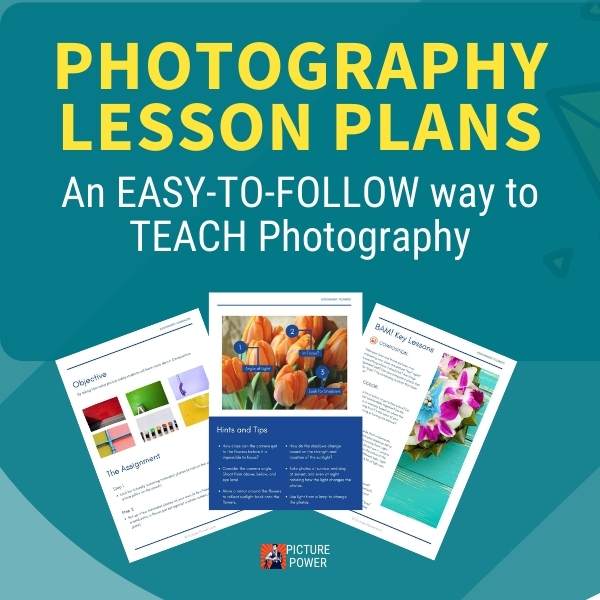
Photography TEACHING & ACTIVITIES KIT (Printables)

Jump right into teaching photography with our exclusive Photography Teaching & Activities Kit
Includes:
- 10 Photography Lesson Plans
- Teacher's Guide
- Student Workbook
- 3 Photography Study Guides
- 30-Day Photography Challenge
- 52 Cut-Out Photo Flash Cards
- Photo Scavenger Hunt
More from picture power


recommended for you
7 Low Light Digital Photography Tips
The test of a good photographer is not how well they shoot in good light, but how they handle a low-light situation. Here are some basic tips on shooting low light digital photography.
Engagement Photo Ideas For Wedding Photographers And Couples
Whether you use props, matching outfits or a unique setting, get inspired with these engagement photo ideas.
Fun Photography Ideas | Tips for photographing toys and memorabilia
These fun photography ideas can turn a boring day into a day of adventure. Give your toys the attention they deserve and learn how to think like a cinematographer.


A COMPLETE PHOTOGRAPHY TEACHING KIT
10 fun, ready-to-teach lesson plans & more!


Search
Picture Power