creative classroom activity
6 Thinking Cameras:
A Simple Photography Activity That Teaches Students to See Differently
Help students practice observation, creativity and critical thinking — all they need is a camera or smartphone.
Get the Photography Teaching & Activities Kit
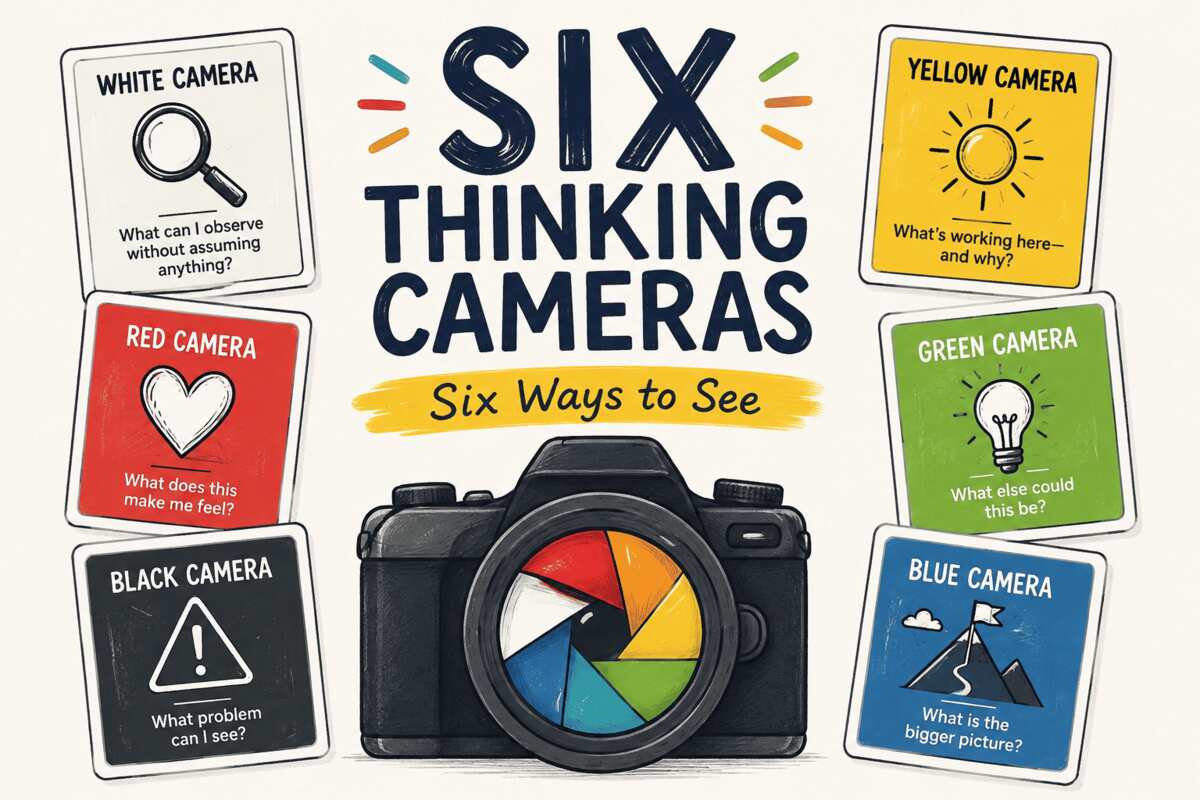
What happens when six students photograph the same thing — but each is looking for something different?
They begin to discover something important: seeing is not the same as looking.
Two people can stand in exactly the same place, look at exactly the same subject, and notice completely different things.
One sees facts.
Another sees feelings.
Someone else notices what is wrong.
Another sees possibilities.
That simple idea is the foundation of 6 Thinking Cameras — an activity that uses photography to help students practice different ways of observing, thinking and responding to the world around them.
And all they need is a camera.
A smartphone will do.
From Six Thinking Hats to Six Thinking Cameras
The idea is inspired by Edward de Bono's well-known Six Thinking Hats method.
De Bono proposed that thinking becomes more productive when we deliberately approach a problem from different perspectives.
His six colored hats represent different modes of thinking: facts, emotions, caution, optimism, creativity and organization.
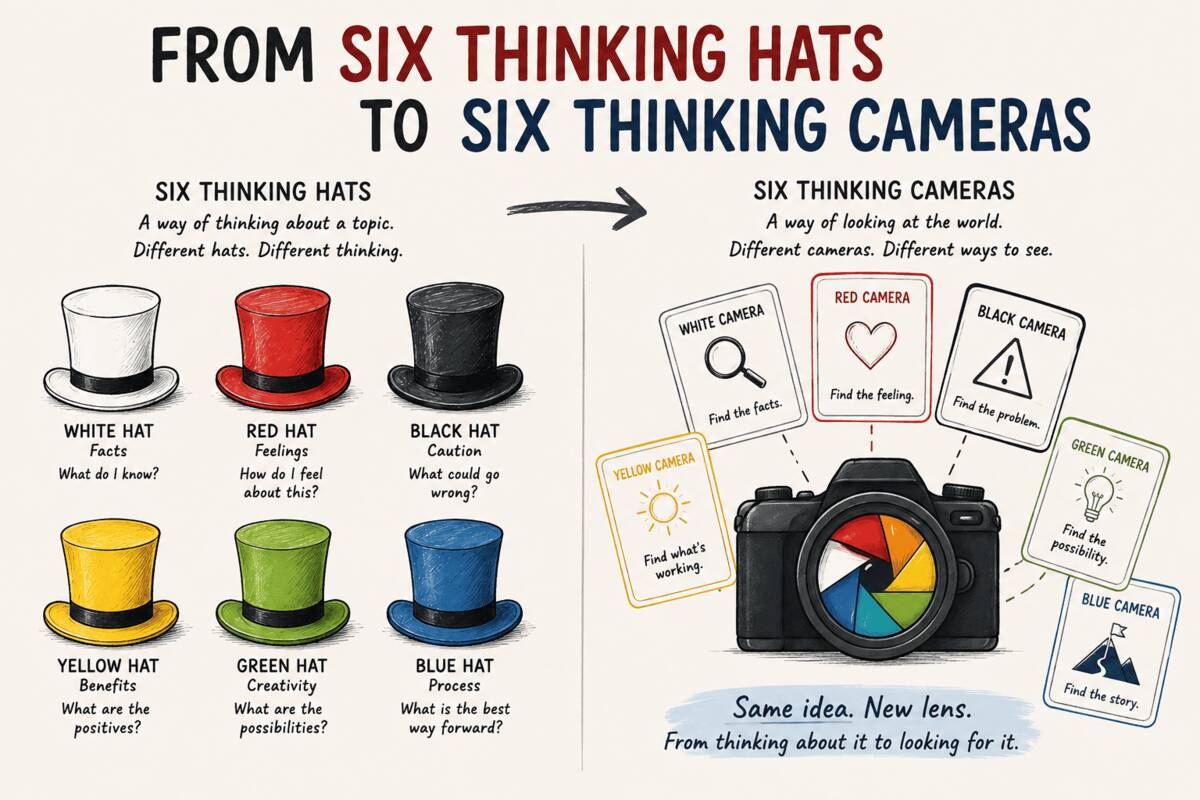
6 Thinking Cameras takes that basic principle and turns it outward.
Instead of asking:
How can I think about this differently?
We ask:
How can I look at this differently?
The camera makes the difference.
Students aren't simply told to consider another perspective. They have to find it, frame it and photograph it.
The abstract act of changing perspective becomes something they can actually do.
What are the six cameras?
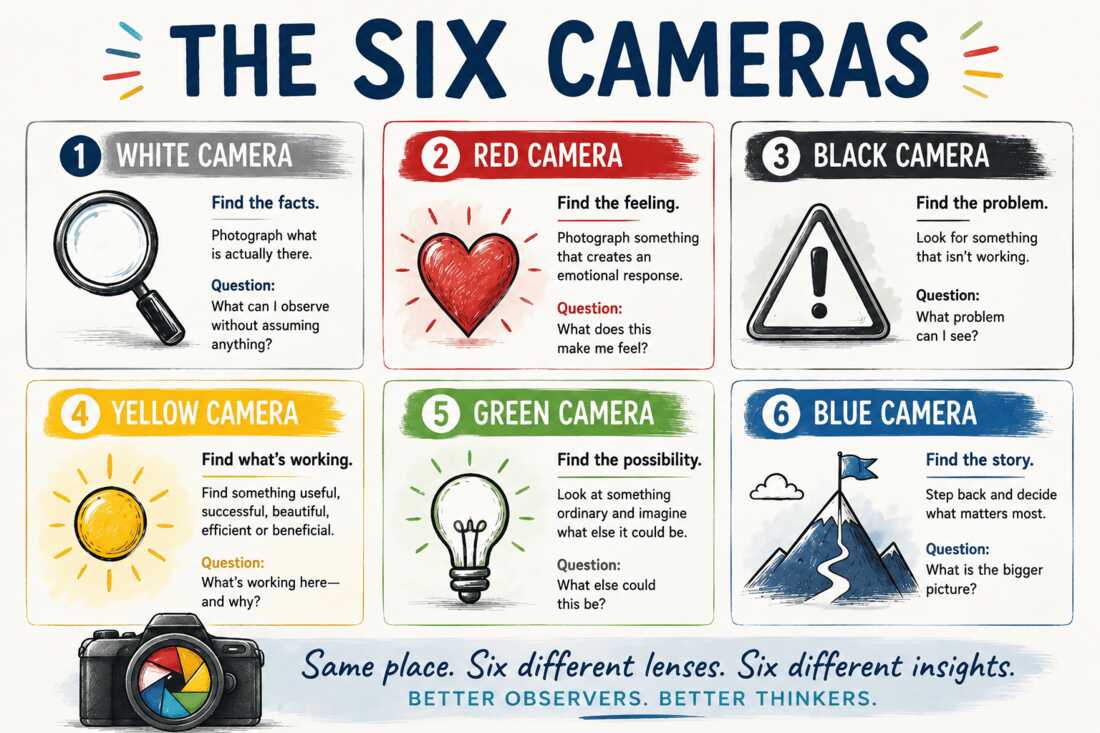
Imagine giving a student six different imaginary cameras. Each camera has only one job.
White Camera — Find the Facts
Photograph what is actually there.
Look for evidence, details, patterns, quantities, conditions and information.
Question: What can I observe without assuming anything?
The White Camera encourages students to separate observation from interpretation.
Red Camera — Find the Feeling
Photograph something that creates an emotional response.
It might suggest happiness, loneliness, tension, comfort, excitement or uncertainty.
Question: What does this make me feel?
Students begin recognizing that images—and environments—can affect us before we ever put those reactions into words.
Black Camera — Find the Problem
Look for something that isn't working.
A broken object. A safety issue. Waste. Confusion. An obstacle. Something that could be improved.
Question: What problem can I see?
The Black Camera turns criticism into careful observation.
Yellow Camera — Find What's Working
Now look in the opposite direction.
Find something useful, successful, beautiful, efficient or beneficial.
Question: What's working here—and why?
Students practice looking for value rather than having it pointed out to them.
Green Camera — Find the Possibility
Look at something ordinary and imagine what else it could become.
Change your angle. Get closer. Photograph a reflection. Find an unusual relationship between two objects.
Question: What else could this be?
The Green Camera encourages experimentation, imagination and visual problem-solving.
Blue Camera — Find the Story
Step back.
Look at everything you've observed and decide what matters.
What photograph—or sequence of photographs—best communicates what you discovered?
Question: What is the bigger picture?
The Blue Camera asks students to organize observation into meaning.
the camera changes the exercise
This is where 6 Thinking Cameras moves beyond the original Six Thinking Hats concept.
De Bono's hats help people deliberately change how they think.
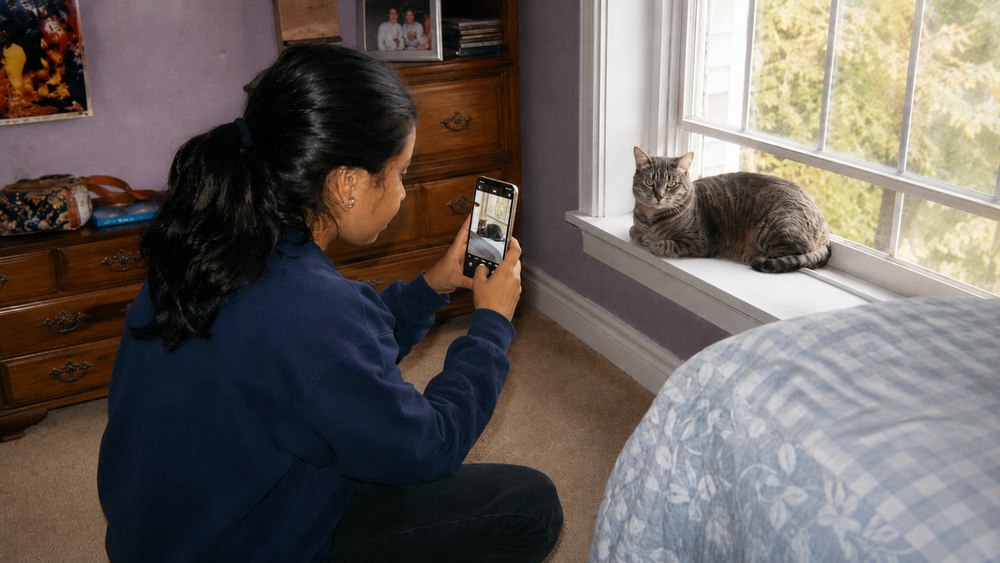
The cameras help students deliberately change how they pay attention.
That's an important distinction.
Tell a student to "look carefully" and the instruction is vague.
Give that student a mission—
Find evidence.
Find a problem.
Find something good.
Find a feeling.
Find a possibility.
Find the story.
—and suddenly there is a reason to look.
The camera gives attention a target.
why photography works so well
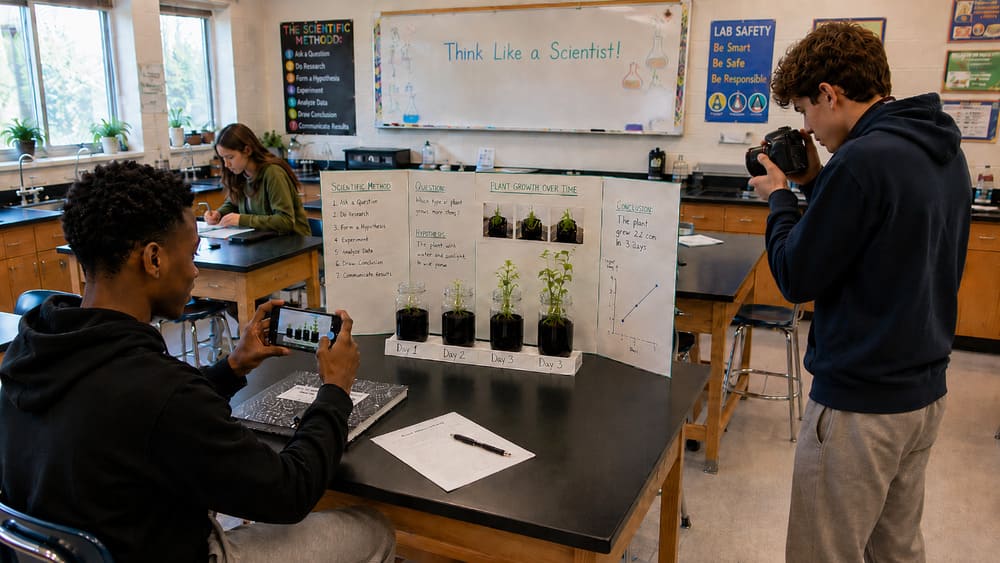
Taking a photograph requires a decision.
Out of everything in front of you:
Why this?
Then another decision:
Why from here?
And another:
What should I include—and what should I leave out?
Those decisions happen every time someone makes a photograph, even with a smartphone.
Photography therefore becomes much more than an art activity.
It can become an observation tool.
Students aren't simply consuming information. They are searching their environment for evidence, relationships, problems, emotions and possibilities.
They become participants.
try it in almost any classroom
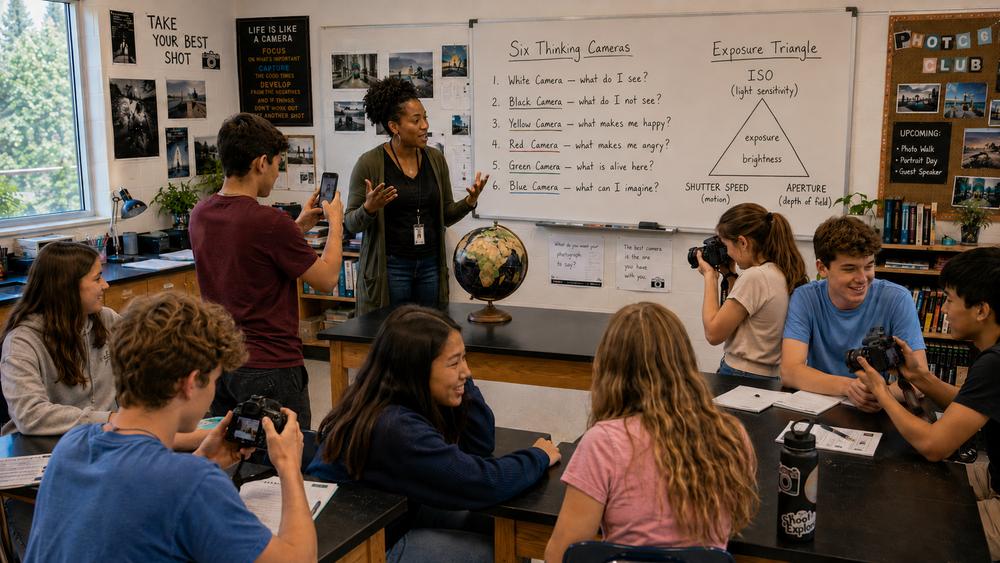
The activity doesn't require a photography class.
A science teacher might ask students to use the White Camera to document evidence of change.
A social studies class could use the Black and Yellow Cameras to examine how a public space serves—or fails to serve—the community.
students could use the Red Camera to photograph mood and the Blue Camera to build a visual story.
Math students could search with the White Camera for patterns, symmetry, scale and geometry.
Younger students can simply walk around the classroom looking for six different ways to photograph the same familiar environment.
The subject changes.
The act of observation remains.
try it at home
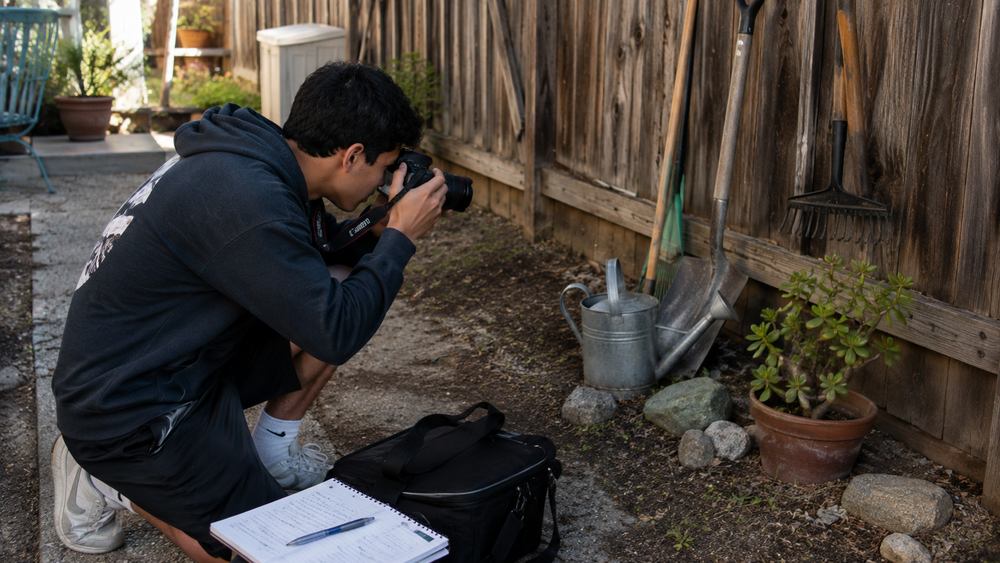
The same exercise works with families.
Choose a room, backyard, park or neighborhood and give everyone one Thinking Camera.
One person searches for facts.
Another searches for feelings.
Another looks for problems.
Another looks for what's working.
Another searches for possibilities.
Another looks for the larger story.
Then compare the photographs.
The interesting part isn't deciding whose photograph is best.
It's discovering what everyone noticed.
You may have been standing beside each other the entire time and still experienced the place differently.
That is the lesson.
Photography Is a Way of Paying Attention

We often think of photography as a way to record what we see.
But photography can also teach us how to see.
Give six people the same subject and six different reasons to look, and they will begin discovering six different versions of the same place.
Nothing in front of them changed.
What changed was their attention.
And once students discover that they can intentionally change the way they look at something, the camera becomes more than a device for taking pictures.
It becomes a tool for thinking.
Before we teach students what to see, we can give them better reasons to look.
Photography TEACHING & ACTIVITIES KIT (Printables)

Jump right into teaching photography with our exclusive Photography Teaching & Activities Kit
Includes:
- 10 Photography Lesson Plans
- Teacher's Guide
- Student Workbook
- 3 Photography Study Guides
- 30-Day Photography Challenge
- 52 Cut-Out Photo Flash Cards
- Photo Scavenger Hunt
More from picture power



recommended for you
7 Low Light Digital Photography Tips
The test of a good photographer is not how well they shoot in good light, but how they handle a low-light situation. Here are some basic tips on shooting low light digital photography.
Engagement Photo Ideas For Wedding Photographers And Couples
Whether you use props, matching outfits or a unique setting, get inspired with these engagement photo ideas.
Fun Photography Ideas | Tips for photographing toys and memorabilia
These fun photography ideas can turn a boring day into a day of adventure. Give your toys the attention they deserve and learn how to think like a cinematographer.



A COMPLETE PHOTOGRAPHY TEACHING KIT
**BRAND NEW FOR 2026!





Search
Picture Power